
AKC obedience titles in order, OTCH points and title tracker
AKC obedience climbs from BN and CD to the UD, and from there the counting starts: UDX legs, OM points from every score of 190 or more, and OTCH points that depend on how many dogs were in the class. Below is each title in order with what it takes, both points schedules, a free helper that turns one Open B or Utility B run into OTCH and OM points, and how dogs get into the Obedience Classic and the National Obedience Championship. Add each run with its score, plus any OTCH points from your results, and the tracker keeps every obedience title, leg and point current.
3 months free. Full access included. Then $5/month.
What are the AKC obedience titles in order?
The AKC obedience titles in order are BN, CD, CDX, UD, UDX, OM, OGM and then the OTCH, and every obedience Q is a score of at least 170 out of 200 with more than half the points on each exercise. BN is optional, so plenty of dogs start at CD. Your dog needs its CD to enter Open and its CDX to enter Utility, and once it has the UD, the Open B and Utility B runs start counting toward everything after it.
| Order | Title | Class | What it takes |
|---|---|---|---|
| 1 | BN, Beginner Novice (optional) | Beginner Novice A or B, on leash except the recall | Qs at 3 trials |
| 2 | CD, Companion Dog | Novice A or B | Qs at 3 trials |
| 3 | CDX, Companion Dog Excellent | Open A or B | Qs at 3 trials |
| 4 | UD, Utility Dog | Utility A or B | Qs at 3 trials |
| 5 | UDX, Utility Dog Excellent | Open B and Utility B | After the UD, a Q in both classes at the same trial, at 10 trials. UDX2 at 20, UDX3 at 30 |
| 6 | OM, Obedience Master | Open B and Utility B | After the UD, 200 points from scores of 190 or more, at least 60 from each class. A new level every 200 points, OM1 to OM9 |
| 7 | OGM, Obedience Grand Master | Open B and Utility B | The 10th level of OM points, 2,000 in all. Awarded once |
| 8 | OTCH, Obedience Trial Champion | Open B and Utility B | After the UD, 100 points plus 3 first places (one in Utility B, one in Open B, one more) under 3 different judges. OTCH2 the next time |
The titles and numbers come from the AKC Obedience Regulations, Chapters 3 to 8 and 16. The A classes are for newer handlers: in Novice A, for example, the handler has never handled a dog that earned a Novice, Open or Utility title. After your dog finishes a title from an A class it can stay in that A class for 60 more days before moving to B.
The obedience row on our AKC title tracker page lists this ladder next to every other AKC sport, and the obedience jump heights are on the dog jump height chart. If you’re weighing obedience against rally, our AKC rally page compares the two side by side.
What does CD, CDX or UD after a dog’s name mean?
CD after a dog’s name means Companion Dog, CDX means Companion Dog Excellent and UD means Utility Dog, and each one says the dog qualified at three AKC obedience trials in Novice, Open or Utility. AKC’s records show only the highest one, so “UD” already includes the CD and CDX. The OTCH is different: it goes in front of the name, like a conformation CH, so a made-up dog might read “OTCH Ruby UDX OM2”, an Obedience Trial Champion with a UDX and two OM levels.
What are the AKC CD title requirements?
For a CD your dog needs qualifying scores in Novice at three AKC licensed or member obedience trials, and a qualifying score means 170 or more out of 200 with more than half the points on every exercise. Novice has six exercises: heel on leash and figure eight, stand for examination, heel free, recall, sit stay (get your leash), and a group sit and down stay. There’s no minimum number of dogs in the class, so a Q in a class of two counts the same as a Q in a class of twenty.
Novice A is for dogs without a CD, handled by their owner or a family member who has never handled a dog that earned a Novice, Open or Utility title. Novice B is open to anyone handling, so trainers and experienced handlers enter B. Beginner Novice (BN) is a gentler optional start with five exercises, all on leash except the recall, and a dog with a CD can still enter Beginner Novice B. Dogs can compete from 6 months old, and mixed breeds enter through AKC Canine Partners once spayed or neutered (minimum ages for every sport).
What are the AKC UDX requirements?
A UDX takes a Q in Open B and a Q in Utility B at the same trial, at 10 trials, and only trials after your dog earned its UD count. Handlers call that same-trial pair a double Q (or a UDX leg). The title repeats: UDX2 at 20 double Qs, UDX3 at 30, and so on, so the number after the letters tells you how many sets of 10 the dog has.
Dogs that already have the UDX keep entering Open B and Utility B, and every double Q they earn there also comes with scores that can add OM points and placements that can add OTCH points. A weekend of B classes moves three counts at once.
How do OM and OGM points work?
Once your dog has its UD, every Open B or Utility B score of 190 or more earns OM points, and 200 of them earn an Obedience Master title, with at least 60 from each class. The points go by score: 6 for 190 to 191.5, 9 for 192 to 194.5, 12 for 195 to 196.5, and 15 for 197 to 200 (Obedience Regulations, Chapter 7, Section 3).
| Score | 190 to 191.5 | 192 to 194.5 | 195 to 196.5 | 197 to 200 |
|---|---|---|---|---|
| OM points | 6 | 9 | 12 | 15 |
Each 200 points is a level, and points past 200 carry over to the next one: OM1, OM2 and so on up to OM9. Finishing the 10th level, 2,000 points in all, earns the OGM, Obedience Grand Master, which is awarded only once. For a sense of scale, a dog scoring 195 in both classes every trial earns 24 points a trial, so the first OM takes 9 trials (216 points), and the OGM takes 84.
What are the requirements for an OTCH?
An OTCH takes 100 championship points plus three first places, all earned in Open B or Utility B after your dog has its UD. One first has to be in Utility B with at least 3 dogs in competition, one in Open B with at least 5, and the third in either class under the same conditions. The three firsts must come under three different judges, and only one of them can be from a specialty show or a Junior Obedience Showcase.
Worked example. Here’s one weekend for a dog that already has its UD:
| Run | Dogs in competition | Placement and score | OTCH points | OM points |
|---|---|---|---|---|
| Saturday Utility B | 15 | 1st, 196 | 14 | 12 |
| Saturday Open B | 22 | 2nd, 197.5 | 3 | 15 |
| Sunday Open B | 12 | 4th, 197 | 1 | 15 |
| Sunday Utility B | 9 | 3rd, 194 | 0 | 9 |
That’s 18 OTCH points, 51 OM points (30 from Open B, 21 from Utility B), one Utility B first that counts toward the OTCH, and two UDX legs, as long as each day’s two runs were at the same trial. The Sunday Open B point is the easy one to miss: 4th of 12 earns nothing on the schedule, but a qualifying score of 197 or better earns 1 point when the schedule gives none. The Sunday Utility B 3rd earns nothing, because 3rd place in Utility B earns points only from 11 dogs up.
How are OTCH points calculated?
OTCH points come from your placement (1st to 4th) and the number of dogs in competition in Open B or Utility B, and a qualifying score of 197 or better earns 1 point if the schedule gave none. Dogs that were excused or disqualified by the judge don’t count toward the number in competition (Obedience Regulations, Chapter 8, Sections 2 and 5).
Open B OTCH points
| Dogs in competition | 1st | 2nd | 3rd | 4th |
|---|---|---|---|---|
| 5 to 9 | 2 | 1 | 1 | 0 |
| 10 to 14 | 4 | 1 | 1 | 0 |
| 15 to 19 | 6 | 2 | 1 | 0 |
| 20 to 24 | 10 | 3 | 1 | 1 |
| 25 to 29 | 14 | 4 | 2 | 1 |
| 30 to 34 | 18 | 5 | 2 | 1 |
| 35 to 39 | 22 | 7 | 3 | 1 |
| 40 to 44 | 26 | 9 | 4 | 2 |
| 45 to 49 | 30 | 11 | 5 | 2 |
| 50 to 64 | 34 | 13 | 6 | 3 |
Utility B OTCH points
| Dogs in competition | 1st | 2nd | 3rd | 4th |
|---|---|---|---|---|
| 3 to 4 | 2 | 0 | 0 | 0 |
| 5 to 7 | 4 | 1 | 0 | 0 |
| 8 to 10 | 6 | 2 | 0 | 0 |
| 11 to 13 | 10 | 3 | 1 | 0 |
| 14 to 16 | 14 | 4 | 1 | 0 |
| 17 to 19 | 17 | 5 | 2 | 0 |
| 20 to 23 | 20 | 7 | 2 | 1 |
| 24 to 26 | 24 | 9 | 3 | 1 |
| 27 to 29 | 27 | 11 | 4 | 1 |
| 30 to 32 | 30 | 13 | 4 | 2 |
| 33 to 36 | 33 | 14 | 5 | 2 |
| 37 to 40 | 37 | 15 | 6 | 3 |
| 41 to 56 | 40 | 17 | 7 | 3 |
Utility B starts paying at 3 dogs and Open B at 5. Small Utility B classes have their own higher scale in Hawaii (up to 13 dogs) and in Alaska and Puerto Rico (up to 10 dogs). The helper below uses the regular scale, so check Chapter 8, Section 5 for trials there.
OTCH and OM points from one run
Free to use. No account needed.
How the helper works: it finds your class size in AKC’s table for Open B or Utility B and reads the points for your placement. If that’s 0 and the score is 197 or more, it gives the 1 point instead. It adds the OM points for the score from the OM table and tells you whether a first place had enough dogs to count toward the OTCH. One example: 1st of 15 in Utility B with a 196 is 14 OTCH points and 12 OM points, and that first counts.
What are the Preferred, Graduate and Virtual obedience titles?
The Preferred titles follow the same ladder as the regular ones, with lower jumps and a few changes to the exercises, and they run from PCD through PCDX and PUTD to the PUDX and the POC. The Graduate and Versatility classes are optional titling classes, and the virtual titles are earned from video.
| Title | Class | What it takes |
|---|---|---|
| PCD, Preferred Companion Dog | Preferred Novice | Qs at 3 trials |
| PCDX, Preferred Companion Dog Excellent | Preferred Open | Qs at 3 trials |
| PUTD, Preferred Utility Dog | Preferred Utility | Qs at 3 trials |
| PUDX, Preferred Utility Dog Excellent | Preferred Open and Preferred Utility | After the PUTD, a Q in both classes at the same trial, at 10 trials. PUDX2 at 20 |
| POC, Preferred Obedience Champion | Preferred Open and Preferred Utility | After the PCDX and PUTD, 750 points from scores of 190 or more (the OM table) and a Q in both classes at 20 trials. POC2 at 1,500 points and 40 |
| GN, Graduate Novice | Graduate Novice | Qs at 3 trials |
| GO, Graduate Open | Graduate Open | Qs at 3 trials |
| VER, Versatility | Versatility | Qs at 3 trials |
AKC’s virtual obedience program has Virtual Beginner Novice and Virtual Novice classes, judged from a video you send in, and its titles (BN-V and CD-V) stand on their own with no crossover to the regular titles.
How do you qualify for the AKC Obedience Classic?
To enter the AKC Obedience Classic your dog needs the title for its class plus three Qs in that class during the qualifying period, July 1 to June 30, or one High Scoring Dog in the Regular Classes award from that class. Masters is the exception and asks for scores of 193 or better. The Classic is held in December alongside the AKC National Championship in Orlando, and Regular and Preferred dogs compete together in the same classes.
| Classic class | Title needed | In the qualifying period |
|---|---|---|
| Novice | CD | 3 Novice Qs (A or B), or one High Scoring Dog from Novice |
| Open | CDX | 3 Open Qs, or one High Scoring Dog from Open |
| Utility | UD (not an OTCH) | 3 Utility Qs, or one High Scoring Dog from Utility |
| Masters | UD (OTCH dogs welcome) | 6 Open B scores of 193 or more and 6 Utility B scores of 193 or more |
Preferred dogs qualify the same way with the PCD, PCDX or PUTD and the Preferred classes. Your dog can enter one class only, the highest it qualifies for. A Novice dog can earn up to two Open Qs in the period and still enter Novice, and an Open dog up to two Utility Qs. The details are in AKC’s Classic criteria for the next event, and AKC’s Obedience Classic Eligibility Report (under Competitor Reports in the AKC Shop) shows where your dog stands. Dates and entries are on the Obedience Classic page.
How do you qualify for the AKC National Obedience Championship?
The AKC National Obedience Championship is by invitation, and a dog gets one by ranking in the top 25 of all breeds for OTCH points, ranking sixth or better for OTCH points within its breed, or finishing in the top four at a regional qualifying competition. In breeds with more than 30 dogs that earned an OTCH point in the period, AKC also invites another 10% of that breed. Dogs listed with AKC Canine Partners count as one breed.
The qualifying period runs December 1 to November 30, and the championship is held in July. For the regional route, your dog needs its UD before the regional and has to enter both Open B and Utility B at all three trials of that regional, and dogs are ranked by their total score, 1,200 being perfect. The winner earns the title NOC, which goes in front of the dog’s name. AKC’s National Obedience Championship rankings show the current top 25 and each breed’s top dogs, and the championship page has the dates.
How do AKC obedience breed rankings work?
AKC publishes obedience rankings for all dogs and within each breed, with lists for Novice, Open and Utility and a separate list by OTCH points. The class lists take dogs in the A and B classes that don’t have an OTCH yet. The OTCH list counts only points earned after a dog’s first OTCH. AKC posts mid-year and year-end lists on its obedience rankings page, and All American Dogs (AKC’s listing for mixed breeds) get their own row in the breed lists.
Frequently asked questions
How many points do you need for an OTCH?+
100 points, plus three first places: one in Utility B with at least 3 dogs, one in Open B with at least 5, and one more, under three different judges. Points count only after your dog has its UD.
Do OTCH points count before the UD?+
No. AKC records OTCH points, OM points and UDX legs only for dogs that have their UD. Before that, Open B and Utility B Qs still count toward the CDX and UD.
What score earns OM points?+
Any Open B or Utility B score of 190 or more earns 6 to 15 OM points once your dog has its UD. A 197 or better earns the full 15.
What is a qualifying score in AKC obedience?+
170 or more out of 200, with more than half the points on every exercise. A high total with one failed exercise is not a Q.
Can an OTCH dog enter the Obedience Classic?+
Yes, in Masters. OTCH dogs can’t enter the Utility class there.
Is the points helper official?+
No. It’s an estimate from AKC’s published point tables, and your dog’s AKC record is the official count. Dog Title Tracker isn’t affiliated with AKC.
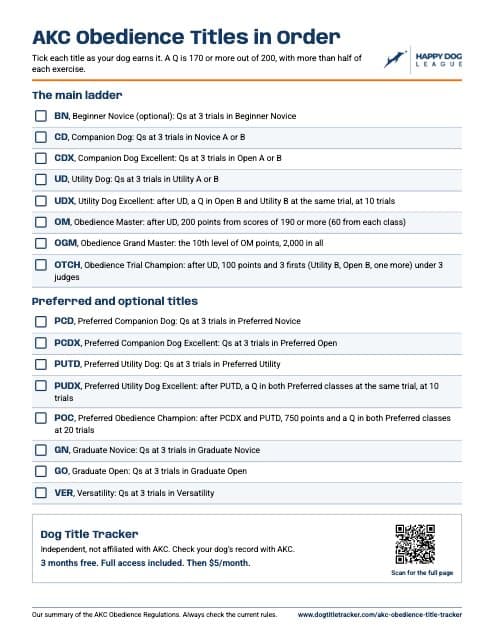
Print the AKC obedience title checklist
One page with every AKC obedience title in order, what each takes and a box to tick, plus a second page with the OTCH and OM points tables. It prints fine in black and white, so it can go in your training bag.
AKC obedience title tracker
Obedience is a lot of counting: legs for the first titles, double Qs for the UDX, and two kinds of points after the UD that are easy to lose track of. Add each run with its score after the trial, and say Open B or Utility B where it matters, and the tracker keeps every title current. It works out the OM points from each score, counts the UDX legs, and adds up the OTCH points and first places you enter from your results. It’s an independent tracker, so your dog’s AKC record stays the official one.
3 months free. Full access included. Then $5/month.
Independent tracking note
Dog Title Tracker is an independent tracking tool. It is not affiliated with, endorsed by, sponsored by, or officially connected to AKC or any other dog sport organization, registry, club, event provider, or governing body listed on this site.
The tracker is for personal tracking and organization. Users should always verify official points, qualifying scores, titles, awards, eligibility, and records directly with the appropriate organization.