
AKC ISC Agility Run Log
ISC is the AKC class where nobody's counting Qs. There are no titles and no legs, just international-style courses, a score made of faults and time, and placements for the top four.
Since there's nothing to earn, ISC runs are easy to lose track of. Below is how ISC works, and the run log keeps every run your dog does, with its faults, time, and placement, in one place.

What Is AKC ISC Agility?
AKC ISC (International Sweepstakes Class) is a non-titling AKC agility class run on international-style courses under rules based on the FCI's. There are no Qs: dogs are placed on faults and then time, any AKC dog can enter any of its three levels, and dogs can jump their AKC height or their FCI height.
The FCI is the international federation behind the Agility World Championship, which is why ISC courses feel different from a regular AKC Standard or Jumpers course. Clubs can offer ISC alongside a regular AKC trial, on special event days, or at trials that run nothing but ISC.
What ISC Courses Are Like
ISC courses are built to FCI design guidelines, and the people who design them describe them as longer, faster, and more technical than a regular AKC course. The obstacles tend to be spread farther apart, so your dog gets long lines to open up on, and you'll need to be somewhere useful when they arrive.
Expect the kinds of challenges you see at international events: back side jumps, a tunnel tucked under the dog walk, obstacles you have to send your dog past while you take a shortcut, and two obstacles side by side where your dog has to pick the right one. Distance skills and a strong verbal "go around" earn their keep here.
If you also run UKI, some of this will feel familiar: UKI courses are more spread out with more backsides too, which is what I found running Moose in both.
Here are two real ISC courses from the same trial, ring, and judge, so you can see how much Level 3 asks for compared with Level 1.
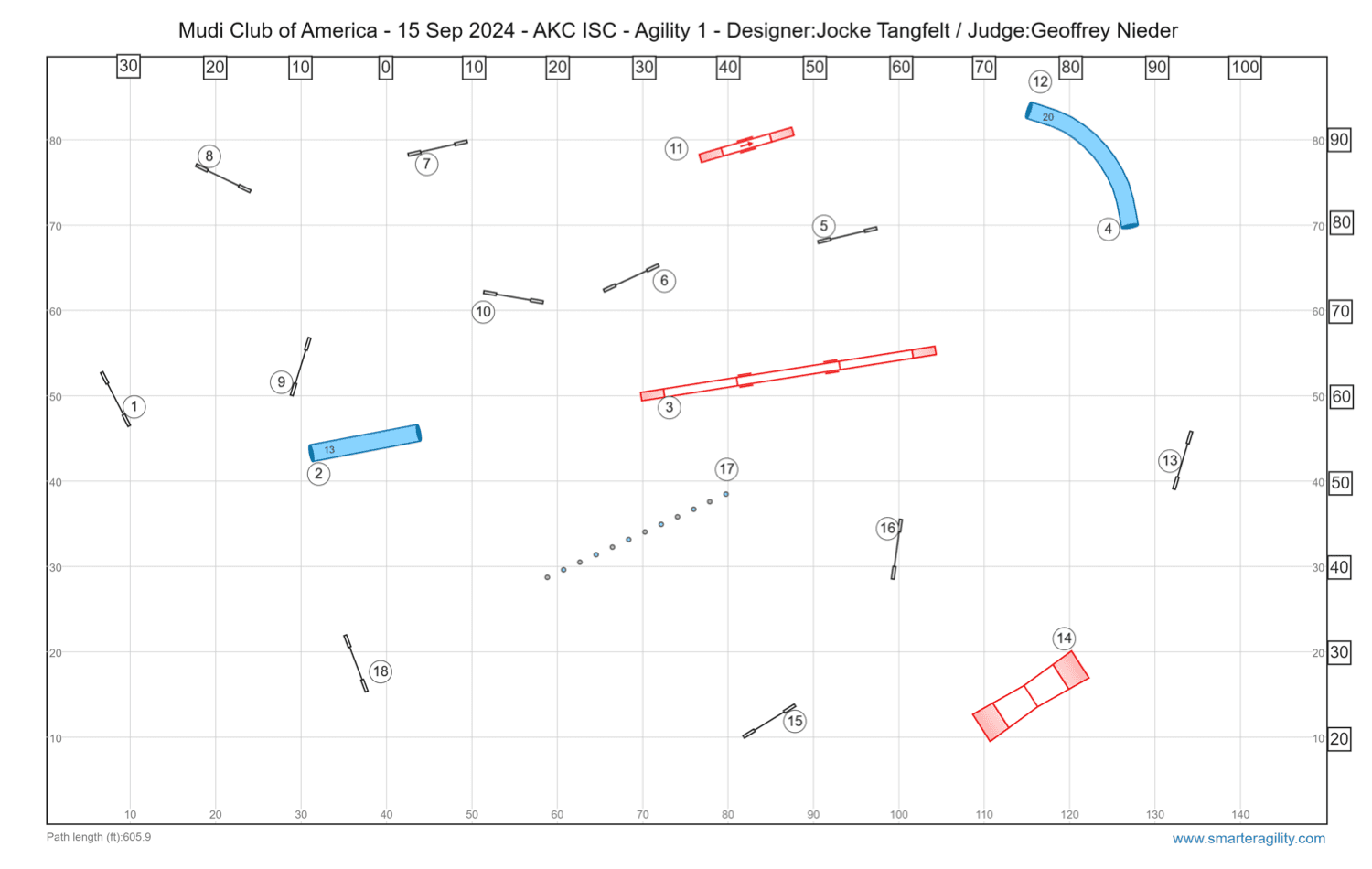
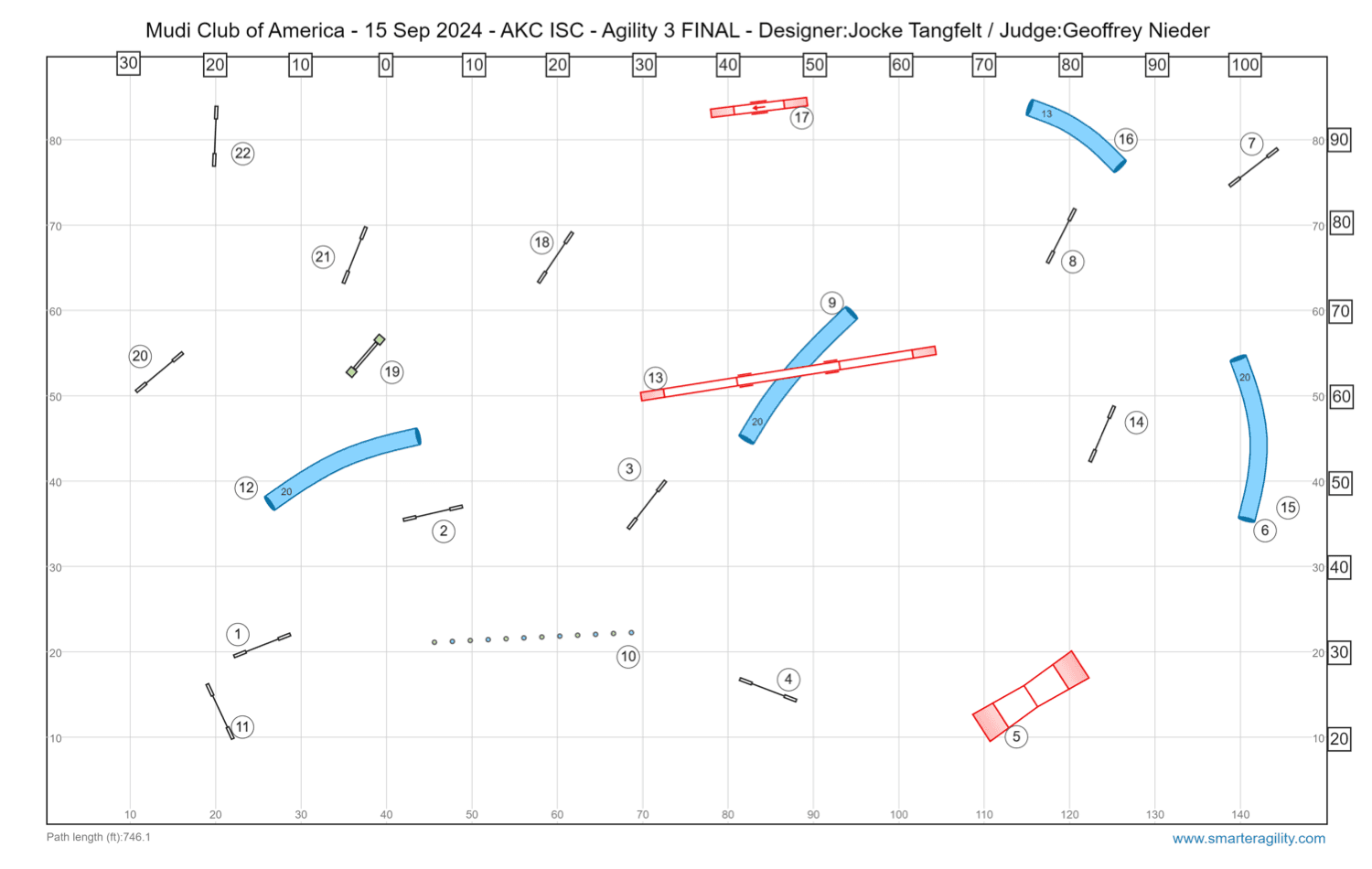
Courses designed by Jocke Tangfelt and judged by Geoffrey Nieder at the Mudi Club of America's ISC trial on September 15, 2024, from the club's posted course maps.
The Six ISC Classes
There are two kinds of ISC class, each offered at three levels. ISC Agility is the standard-style course with contacts, and ISC Jumping is the jumpers course with weaves.
| Class | What the course is | Levels |
|---|---|---|
| ISC Agility | Standard-style course with contacts | 1, 2 and 3 |
| ISC Jumping | Jumpers course with weaves | 1, 2 and 3 |
There's no moving up. Your dog can enter any level, and even more than one level at the same trial, so a dog new to ISC can start at Level 3 if you're feeling brave.
How ISC Is Scored
Every dog starts at zero, and faults get added from there. Most mistakes, like a knocked bar, a missed contact, or popping out of the weaves after a correct entry, cost 5 faults, and every full second over the standard course time costs 1 more. The maximum course time is the standard course time plus 20 seconds, and three refusals is an elimination.
Placements go by faults first and then time, so a dog with 5 faults can still take home a ribbon, which is a nice change from regular AKC agility. Eliminated dogs don't place, and two dogs tied on faults and time go to a run-off.
Here's how one class could shake out with a standard course time of 40 seconds. Dog B wins because it's clean and fastest, Dog C still places third with a time fault, and Dog D takes fourth with a knocked bar even though it ran the quickest time of all.
| Dog | Time | Course faults | Time faults | Total faults | Place |
|---|---|---|---|---|---|
| A | 38.42 s | 0 | 0 | 0 | 2nd |
| B | 35.90 s | 0 | 0 | 0 | 1st |
| C | 41.70 s | 0 | 1 | 1 | 3rd |
| D | 34.80 s | 5 | 0 | 5 | 4th |
| E | Eliminated | No place |
ISC Course Times
The judge sets each standard course time, within a speed range AKC gives for each class and size. The course is measured, then divided by the speed the judge picks, and the course can be no longer than 240 yards.
| Size | Jump heights | ISC Agility (yards per second) | ISC Jumping (yards per second) |
|---|---|---|---|
| Small | 8 and 12 in | 2.75 to 3.50 | 3.50 to 4.00 |
| Medium | 16 in | 3.00 to 3.75 | 3.75 to 4.25 |
| Intermediate | 20 in | 3.50 to 4.25 | 4.00 to 4.50 |
| Large | 24 in | 3.50 to 4.25 | 4.00 to 4.50 |
Dogs jumping 8 or 12 inches share the Small course time, 16 inches gets the Medium time, 20 inches gets the Intermediate time, and 24 inches gets the Large time. So a 180-yard ISC Agility course judged at 3.5 yards per second gives a standard course time of about 51 seconds.
ISC Jump Heights
| FCI category | Dog measures | Jumps |
|---|---|---|
| Small | 13 3/4 in or less | 12 in |
| Medium | 16 7/8 in or less | 16 in |
| Intermediate | 18 7/8 in or less | 20 in |
| Large | Over 18 7/8 in | 24 in |
Your dog can jump its regular AKC height or its FCI height, and every AKC height is offered except 24C. A dog entered in Preferred is scored with the Regular dogs at the matching height.
If You Read Older ISC Info
ISC has changed since it started, and some older articles still show up in search. If you read that ISC dogs jump 14, 22, or 26 inches, or that only Excellent and Master dogs can enter, that's out of date. Today ISC uses the FCI heights above, and any dog eligible for AKC agility can enter any level.
Finding ISC Trials
ISC shows up in a few places. Many regular AKC trials offer one or two ISC classes a day, special event days can offer up to four, and ISC-only trials can run as many as the club likes. The premium list for each trial will say which ISC classes are offered.
Some ISC events are named World Team Bye Events, which can earn a team an automatic entry to the World Team Tryouts, and AKC also runs regional ISC qualifier events for the Tryouts. AKC's ISC page lists both.
The AKC ISC Championship
Once a year AKC holds the AKC International Sweepstakes Championship, a weekend of ISC rounds. The most recent one, in October 2026, took entries by random draw with a cap of 350 dogs, so watch AKC's championship page for the next entry window.
How ISC Counts Toward the World Team Tryouts
ISC doesn't earn titles, but it can help get you to the AKC/USA World Team Tryouts. Under AKC's Tryouts rules, clean runs in ISC Agility 2 or 3 and ISC Jumping 2 or 3 can count toward the 4 Standard and 4 Jumpers clean runs a dog needs, as long as they're run at the dog's FCI height. In ISC, a clean run means no course faults and no time faults.
There's also a shortcut: at AKC's regional ISC qualifier events, the combined class winner at each height is invited to the Tryouts, as long as the team has at least one clean ISC run there and one with no more than 5 course faults and no time faults. The Tryouts rules can change from year to year, so check AKC's current rules before you start counting.
What the Run Log Keeps
A run log is worth keeping even without titles. It gives you one place to look back over your clean runs when you're counting toward the Tryouts, see whether your dog's times are coming down, and remember which height and which courses went well. Only clean Level 2 and 3 runs at your dog's FCI height count for the Tryouts, so it helps to put the height in the notes.
For each run you log the date, the class, and the level, plus faults, time, placement, and whether your dog was eliminated, if you want them. There's a notes box for the judge, the height, the trial, or the moment your dog took the wrong tunnel with total confidence.
A run with zero faults is marked clean for you, and when you want the whole list on paper, you can print it or save it as a PDF for any date range you choose. ISC gets its own tab on your dog's profile, so it never mixes with your dog's regular AKC titles.
Rules from AKC's Regulations for Agility Trials, Chapter 14, and AKC's World Team Tryouts rules. Last checked October 2026.
Start Your Dog's ISC Run Log
Start with your next ISC run. It's free for 3 months, then $5 a month, with no charge per dog, and the same account covers the other sports and organizations we track.
Independent tracking note
Dog Title Tracker is an independent tracking tool. It is not affiliated with, endorsed by, sponsored by, or officially connected to the AKC or any other dog sport organization, registry, club, event provider, or governing body listed on this site.
The tracker is for personal tracking and organization. Users should always verify official points, qualifying scores, titles, awards, eligibility, and records directly with the appropriate organization.
AKC ISC Questions
Does ISC earn titles or Qs?
No. ISC is a non-titling class, so there are no Qs, legs, or titles. Dogs are placed on faults and then time, and the top four in each size group usually get ribbons.
Can my dog enter more than one ISC level?
Yes. There’s no progression in ISC, so your dog can pick any level, and run in several levels at one trial.
What’s a clean run in ISC?
A run with no course faults and no time faults. The run log marks these for you.
Do ISC runs count toward the World Team Tryouts?
They can. Clean runs in ISC Agility 2 or 3 and ISC Jumping 2 or 3, at your dog’s FCI height, can count toward the 4 Standard and 4 Jumpers clean runs needed. Check AKC’s current Tryouts rules, since they can change each year.
Can my dog run ISC at its regular AKC jump height?
Yes. Your dog can jump its regular AKC height or its FCI height, and every AKC height is offered except 24C.
How is the ISC course time set?
The judge picks a speed within AKC’s range for the class and size, and divides the measured course by it. Dogs jumping 8 and 12 inches share the Small time.
Can I print my ISC runs?
Yes. You can print the log or save it as a PDF, for all runs or a date range you choose.
Is this an official AKC tool?
No. Dog Title Tracker is independent and isn’t affiliated with or endorsed by the AKC. Always check official results and records with the AKC.